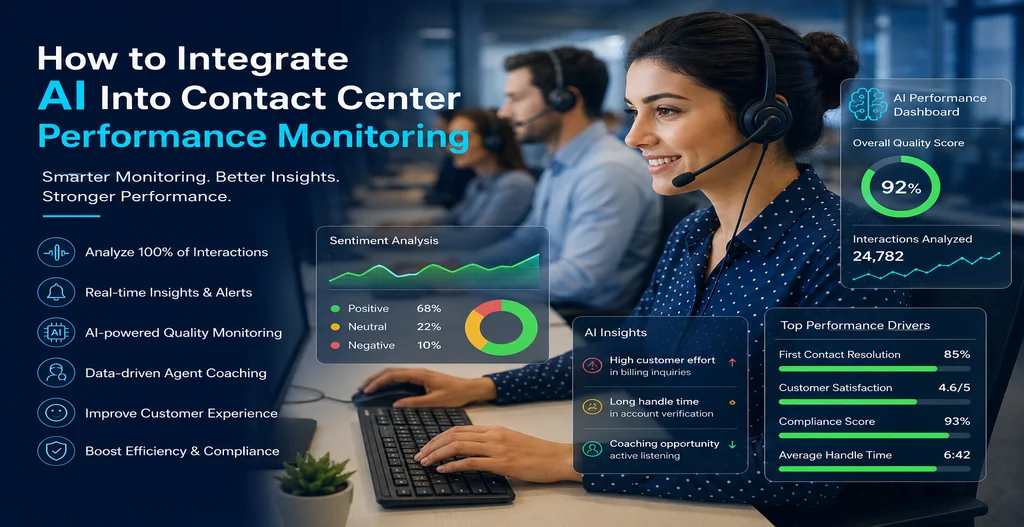
Contact center performance monitoring is evolving rapidly as AI moves from an experimental to an operational technology. If you are asking how to integrate AI into contact center performance monitoring, the answer is to integrate AI with interaction data, quality assurance, customer experience, workforce data, and agent coaching. Rather than manually reviewing a few calls, an AI-enabled system can analyze all interactions at scale, spot performance trends, flag compliance risks, and develop targeted recommendations.
For an integrated contact center, this becomes a continuous cycle of: generation, collection, and analysis of insights on specific behavior, capability gaps, and business impact leading to agent coaching, action, and subsequent measurement of results.
What Is AI-Powered Contact Center Performance Monitoring?
AI-based contact center performance monitoring employs artificial intelligence, speech and text analytics, automation, and machine learning tools that enable tracking and analyzing of agent and customer interactions based on predefined quality standards. This is where AI breaks the mold.
Instead of a handful of calls monitored by supervisors, AI-enabled systems listen to a far greater percentage of calls (as well as digital and other channels). Platforms that are designed for quality management will be able to look at interactions and recognize sentiment and behavioral trends, detect compliance issues, and recommend coaching opportunities.
What we want is much more than automating quality scores. Quality score is a proxy for a signal, and the true goal is to tie performance signals to the right action.
For instance, AI may recognize a very high average handle time of an agent when the customer repeatedly questions a certain process. Rather than simply tagging the agent as low performing, a supervisor can analyze the root cause and offer coaching or enhance the knowledge base.
Why Integrate AI Into Contact Center Performance Monitoring?
The greatest opportunity that AI offers is the potential for scale. Supervisors simply cannot listen to every conversation, but AI can analyze large volumes of interactions consistently. Understanding “what is an inbound call center” also helps businesses identify where AI can improve incoming customer interactions and agent performance.
AI-powered monitoring can help contact centers:
- Evaluate interactions more consistently
- Identify recurring customer complaints
- Detect changes in sentiment and conversational behavior
- Find compliance and script-adherence issues
- Identify coaching opportunities
- Connect quality scores with operational KPIs
- Recognize performance trends before they become larger problems
- Reduce the manual workload associated with quality assurance
Thanks to AI-based quality management, contact centers are evolving from sampling-based monitoring to comprehensive interaction analysis. Industry solutions now support automated evaluation, conversational analytics, real-time insights, and performance management. Solutions for the industry are already on the market that give automated evaluation, conversational analytics, real-time insights, and performance management.
While in particular useful for organizations with many channels, teams, locations, and outsourced activities.
How to Integrate AI Into Contact Center Performance Monitoring
A successful implementation should not begin with buying an AI tool. Develop a clear understanding of what you want AI to watch, and what business results you are looking for.
1. Define the Performance Metrics AI Should Monitor
First of all, determine the KPIs that are most important for your needs.
Common contact center performance metrics include:
- Average Handle Time (AHT)
- First Contact Resolution (FCR)
- Customer Satisfaction (CSAT)
- Service level
- Average Speed of Answer
- Abandonment rate
- Transfer rate
- Agent adherence
- After-call work time
- Quality scores
- Compliance rates
For example, understanding what is an FCR is important because first contact resolution can reveal whether customers are getting their issues resolved without repeated contacts.
Don’t overmeasure just because AI has made measurement easier. Select KPIs that are relevant to customer value and customer experience, the bottom line, or the compliance target.
2. Connect Your Customer and Operational Data
AI becomes significantly more useful when it can access the data needed to understand an interaction in context.
An integrated contact center may bring together:
- Contact center platform data
- CRM records
- Call recordings
- Chat and email conversations
- Workforce management data
- Customer feedback
- Agent performance history
- Knowledge-base information
This is where call center CRM integration becomes important. Connecting CRM and interaction data allows AI to understand customer history rather than evaluating an individual conversation in isolation.
For businesses building or modernizing their infrastructure, contact center implementation for businesses should therefore include a clear data-integration strategy from the beginning.
3. Use AI to Analyze 100% of Interactions Where Appropriate
One of the strongest use cases for AI is automated quality monitoring.
Instead of supervisors manually selecting a few calls, AI can analyze interactions for factors such as:
- Sentiment
- Intent
- Empathy
- Script adherence
- Resolution effectiveness
- Compliance language
- Customer frustration
- Long silences
- Unnecessary transfers
- Repeated customer questions
Today’s AI-powered quality management systems have the processing capacity to monitor voice and digital interactions on a large scale, seeking out trends that can be easily overlooked through traditional sampling.
The importance of quality teams remains even with automated AI scoring. Calibration, review, and periodic model validation are critical to make sure automated scoring is representative of what your organization recognizes as quality.
4. Turn AI Insights Into Agent Coaching
Data alone does not improve performance. Action does.
Once AI identifies a performance gap, connect the insight to coaching.
For example:
- AI detects: An agent frequently interrupts customers.
- Supervisor sees: The behavior occurs primarily during complex support calls.
- Coaching action: The supervisor provides active-listening training.
- Follow-up: AI monitors future interactions to determine whether the behavior improves.
It establishes a closed-loop performance management process rather than a static reporting system.
AI can also help supervisors prioritize coaching by identifying the behaviors most strongly associated with customer dissatisfaction or poor resolution outcomes.
5. Add Real-Time AI Monitoring and Agent Assistance
Not every performance issue needs to be discovered after the interaction.
Real-time AI detects issues during an interaction. On various platforms, it can give agents knowledge recommendations, next-best-actions, prompts, or alerts when the right scenario arises.
For supervisors, real-time monitoring can highlight interactions requiring immediate attention.
This approach is particularly useful for complex service environments where agents need assistance while handling customers rather than receiving feedback days later.
The combination of real-time guidance as well as after-record analytics results in a more robust performance-management cycle.
6. Integrate AI With Contact Center Automation
AI monitoring becomes even more valuable when insights can trigger workflows automatically.
For example:
Interaction analyzed → performance issue detected → coaching task created → supervisor notified → agent coached → future interactions monitored
This kind of workflow can lessen administrative workload and achieve more consistent performance management.
Organizations can also use analytics together with contact center automation tools to automate routine operational processes, such as escalations to the right teams or follow-up actions.
The objective should not be automation for its own sake. Every automated workflow should have a measurable business purpose.
7. Build AI Governance Into the Process
AI must be a tool for supervisors, not operate without oversight.
Before deploying AI-powered monitoring, establish clear rules for:
- Data privacy
- Recording consent
- Sensitive information
- Access permissions
- AI evaluation criteria
- Human review
- Model accuracy
- Employee transparency
- Regulatory compliance
Automated quality monitoring can identify compliance risks and evaluate interactions at scale, but governance remains essential when AI is used to assess employee performance.
Employees should also understand how AI-generated insights are used. If agents believe AI scores are opaque or unfair, adoption can suffer.
AI Metrics to Track After Implementation
The success of AI integration should be measured using business outcomes rather than the number of AI features deployed.
Track changes in:
| Metric | What It Helps Measure |
|---|---|
| FCR | Resolution effectiveness |
| AHT | Interaction efficiency |
| CSAT | Customer experience |
| Quality score | Interaction quality |
| Compliance rate | Policy adherence |
| Transfer rate | First-agent effectiveness |
| Agent productivity | Operational output |
| Coaching completion | Managerial follow-through |
| Repeat contacts | Unresolved customer issues |
Look for relationships between these metrics rather than evaluating them independently. For instance, reducing AHT is not necessarily an improvement if FCR and CSAT decline at the same time.
Common Mistakes When Integrating AI Into Performance Monitoring
AI implementation can go wrong if, as often is the case, the concentration shifts more on the technology, instead of the performance strategy behind it.
Monitoring Too Many Metrics
More information doesn’t necessarily lead to better decisions. Also, choose metrics that set the direction for your customers and company.
Treating AI Scores as Perfect
AI can improve consistency and scale, but its evaluations should be periodically reviewed and calibrated by humans.
Ignoring the Agent Experience
If AI is seen solely as a way of surveillance, agents will oppose it. Present AI as a learning coach and support for the employees.
Keeping Data in Silos
If interaction analytics, CRM information, workforce data, and quality scores remain disconnected, supervisors may struggle to understand the full picture.
Measuring Technology Instead of Outcomes
The question should not be, “How much AI are we using?” It should be, “Is AI helping us improve resolution, quality, efficiency, compliance, and customer experience?”
How AI Fits Into the Future of Contact Center Performance
AI is merging more into a wider contact center environment than being an analytics layer in its own right.
In the future, the integrated contact center will contain the contact points of customers, AI, human agents, CRM systems, workforce management, analytics, and automation into one continuous performance environment.
This also shifts the role of the supervisors: rather than spending most of their time manually scanning through interactions, supervisors’ time can be more concentrated on trend analysis, employee coaching, exception handling, and process improvement.
Questions like “Will AI replace call center agents” are becoming less relevant than the questions how can AI help agents do their jobs better. Human empathy, complex problem solving, and relationship management are still needed, but AI can perform the more repetitive tasks of statistical analysis and maybe even support decisions.
AI also helps businesses monitor call center outsourcing vendors by tracking service quality, compliance, and agent performance.
Organizations should also evaluate how their broader communications infrastructure fits into this strategy, including areas such as CPaaS vs CCaaS and selecting the best unified communications platform for their operational requirements.
Conclusion
The key to understanding how to incorporate AI into performance monitoring in the contact center comes back to a connected system. Data informs you of insight, and insight drives decisions to take action. Choose the right KPIs, connect CRM and interaction data, automate quality monitoring, leverage AI for live agent assistance, and convert performance data into targeted coaching.
The best option would not be substituting supervisors with AI, but having supervisors exposed to a more global picture of what is happening in customer interactions and giving agents more relevant support.
For organizations preparing for an AI-powered transition, knowledgeable contact center consulting services can assist in assessing available technology, integration needs, workflow performance measures, and implementation priorities before significant investments.